When someone asks ChatGPT, Claude, Perplexity or Google’s AI Overviews a question, the answer gets built from websites the AI can read, trust and quote. If your site wasn’t designed for that reader, patching it later rarely works as well as building it right from the first page.
Most websites were built for two audiences: people who skim, and search engines that count keywords and links. A third reader now sits between you and your customer. It doesn’t click around or admire your hero image. It reads your pages, pulls out facts, and decides whether you’re the source worth citing.
That changes how a site should be built. And in a lot of cases, it means the smartest move is to stop renovating and start from scratch.
The family recipe box
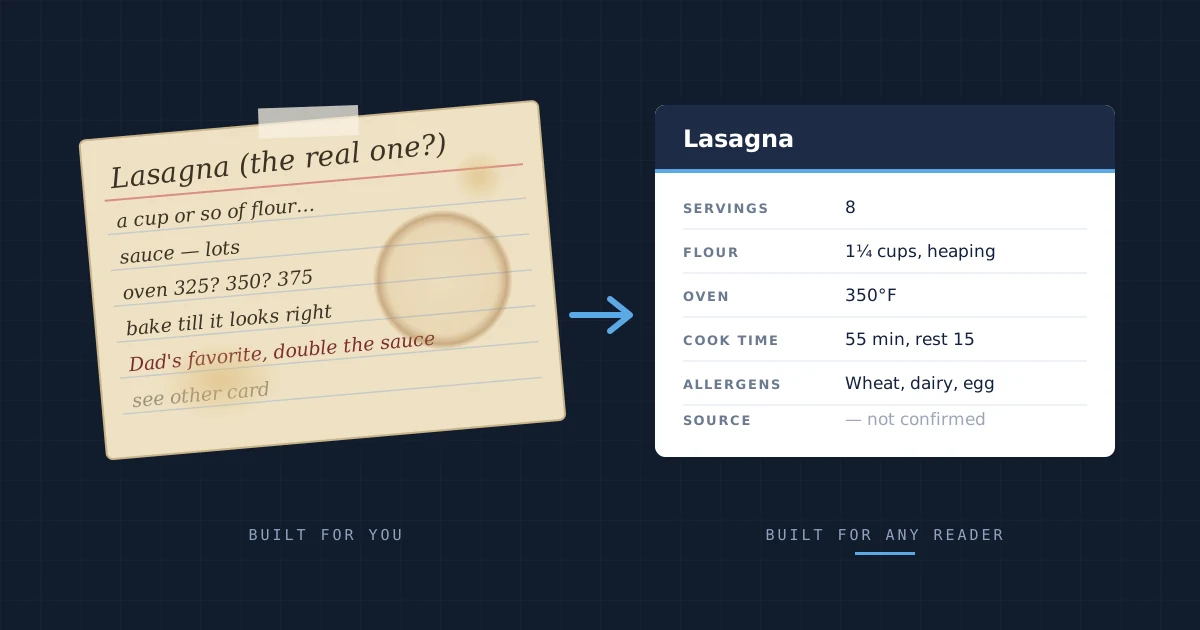
Picture your grandmother’s recipe box. Forty years of cards, napkins and magazine clippings, some in her handwriting and some in her mother’s. The pot roast is on the back of an envelope from 1983. The cookie card has a butter stain right where the oven temperature should be. One lasagna card has a note in the margin: “Dad’s favorite, double the sauce.”
That box is priceless. It holds holidays, Sunday dinners and people who aren’t at the table anymore. You’d grab it in a fire. Nobody should ever throw it away.
But it isn’t efficient.
It only works because you already know it by heart. You know “a cup or so” of flour really means a heaping cup. You know which of the three lasagna versions is the real one. You know the cookies go in at 350 even though the card doesn’t say so. All that knowledge lives in your head, not in the box.
Now imagine handing the box to a friend who has never cooked with your family. You ask them to answer questions fast: How long does the pot roast cook? Which cookies are nut-free? What temperature for the lasagna? They’d flip through stained cards, squint at faded ink and find three answers that disagree. Then they’d either give up or guess.
You could fix the old box one card at a time with cross-outs, sticky notes and staples. You’d still end up with conflicting versions, gaps and stains, because the box was never designed to be read by a stranger.
So you keep the original somewhere safe, for the memories. Then you start a fresh box with one rule: every card uses the same layout. Title, servings, ingredients with exact amounts, oven temperature, cook time, allergens. If something isn’t known, the line stays blank instead of guessed. Now your friend can answer any question in seconds, and you can trust what they say.
In AI search, efficiency is everything
That friend is the AI. It has no memories of your business, no feel for what you meant, and no patience for digging. It’s answering someone’s question in seconds, and it will use whichever source gives it a clear, confident answer the fastest.
Your older website may be a lot like that recipe box. It might hold years of real expertise, loyal clients and genuine local knowledge. That history matters, and it’s worth keeping. But if the facts are scattered across old posts, buried in sales copy or contradicted from page to page, the AI won’t take the time to sort it out. It will quote a competitor whose site is easier to read.
When people searched by clicking through links, a charming but messy site could still win. Now the reader is a machine that rewards efficiency above everything else. A site built from scratch for AI visibility is the new recipe box: consistent, complete, and honest about what it doesn’t know.
Why retrofitting falls short
An older site usually carries years of baggage: thin pages written for keywords, duplicate content, outdated numbers, vague marketing copy, and templates that bury facts inside sliders and pop-ups. You can clean that up, but every fix fights the original structure.
Starting fresh lets you design around what AI systems actually reward:
| What AI needs | Retrofitted site | Built from scratch |
|---|---|---|
| One page per real-world thing | Topics scattered across old posts | A dedicated page for every building, program or question |
| Consistent facts in the same place | Every page laid out differently | The same fields on every page, like the recipe card |
| Direct answers | Answers buried in sales copy | The question as a heading, the answer in the first sentence |
| Freshness | Stale figures nobody remembers to update | Dates on pages and a regular update schedule |
| Trust signals | Unclear authorship and sourcing | A named author, a sourcing policy, links to primary sources |
| Honesty about gaps | Guesses and filler | Blank fields when a fact isn’t confirmed |
The common thread is structure. AI models are very good at reading a page that says the same kind of thing in the same place every time. They’re much worse at untangling a site that grew by accident.
Example 1: ChicagoApartmentBuildings.com
ChicagoApartmentBuildings.com is the recipe box idea applied to Chicago rentals. It’s a searchable directory of 290 apartment buildings holding 79,170 apartments across 13 neighborhoods, from River North and the West Loop to Hyde Park.
Every building gets its own profile page, and every profile uses the same fields: number of units, year built, floors, amenities, pet policy, and the nearest CTA station with its lines and distance. That consistency is what lets a renter, or an AI, ask a precise question and get a precise answer. Which River North buildings allow pets and have in-unit laundry? How far is this tower from the L?
A few choices were made specifically because the site started from zero:
- No guessing. If a fact can’t be confirmed from the building’s own website, its management company or a major listing page, the field stays blank.
- Clear scope. The site doesn’t publish rents or availability, because they change too often to stay accurate. It says so plainly in its FAQ.
- No paid rankings. Buildings aren’t scored, ranked or charged to appear, which keeps the data neutral.
- Data as content. Directory-wide figures, like the 0.2-mile median distance to a CTA station or the share of buildings that are pet-friendly, become quotable facts in their own right.
- Built for machines too. Alongside an A–Z table of every building and a map, the site publishes an AI Instructions page that explains how assistants should use and cite it.
None of this would be easy to bolt onto a typical apartment-marketing site full of “luxury living” copy and expired specials. It works because the structure came first.
Example 2: ChicagoFirstTimeHomebuyer.com
ChicagoFirstTimeHomebuyer.com applies the same thinking to a different problem. First-time buyers ask AI assistants the same questions over and over: How much help can I get? Do I count as a first-time buyer? What does closing cost in Chicago? The site was built so each of those questions has one clear, sourced answer.
Here’s how that shows up on the page:
- Questions as headings, answers up front. “How long is attorney review?” is answered in the first sentence: five business days after your offer is accepted. Then it links to a full page on the topic.
- Hard numbers, not hedging. The HomeGrown grant of up to $70,000, IHDAccess Home up to $15,000 at 0% interest, the buyer’s 0.75% share of the city transfer tax, the 2026 FHA limit of $541,287. These are exactly the figures an AI wants to quote.
- Every fact linked to its source. An editorial standards page explains how facts are checked against the agencies that run each program.
- Built-in freshness. The site posts updates every Tuesday and Friday and shows its last-updated date, covering things like Cook County down payment funding and fall 2026 property tax appeal deadlines.
- A clear path by stage. Visitors pick where they are: just starting, needing down payment help, or looking at a condo or two-flat. Then they follow seven numbered steps to closing.
An older brokerage blog with years of generic “5 tips for buyers” posts could never be patched into this. Rates, limits and program rules change every year, and a stale page is worse than no page, because the AI may repeat it.
Building your own from scratch
If you’re starting a site for AI visibility, here’s the short version of what both sites have in common:
- Pick a narrow subject you can cover completely. 290 buildings in one city, or first-time buying in one city. Depth beats breadth.
- Design the “recipe card” before you write a page. Decide the fields every page will carry, then fill them the same way every time.
- Give every real-world thing its own page. One building, one program, one question.
- Lead with the answer. Put the question in the heading and the answer in the first sentence.
- Source everything, and leave gaps blank. A missing fact is honest. A guessed one can get repeated by an AI to thousands of people.
- Show who’s behind it. A named, licensed author and a clear sourcing policy build the trust AI systems look for.
- Keep it fresh on a schedule. Dates on pages, regular updates, and old figures replaced, not left to drift.
The takeaway
You wouldn’t fix a forty-year-old recipe box with sticky notes if you wanted someone else to cook from it. You’d keep it safe, start a clean box with one layout, and fill it carefully.
Websites are the same now. When AI is the one reading your site and answering for you, the cleanest structure wins. Sometimes the fastest way to get there is a blank page.